
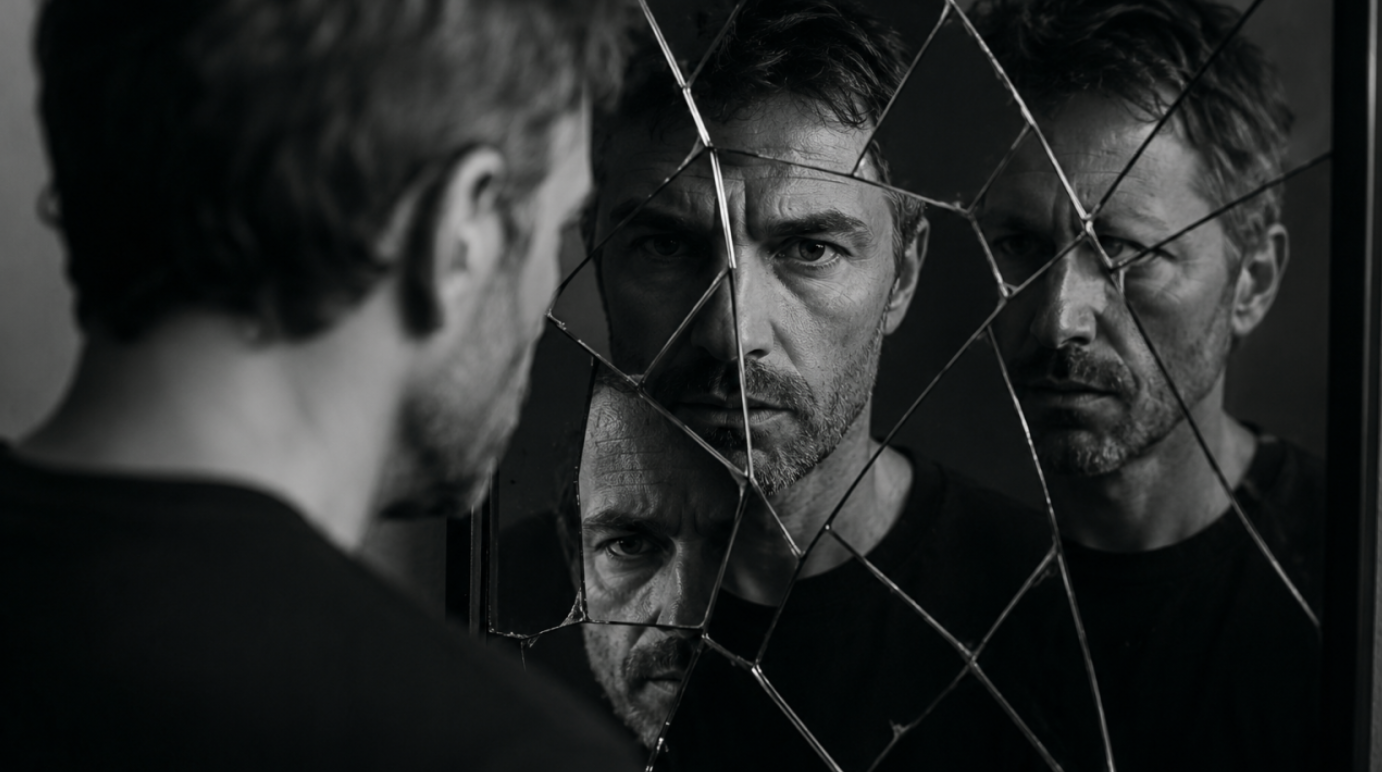
It is February 2008 and yet another seven-year relationship has ended.
It is, of course, absolutely not my fault.
Oh no, I’d simply picked the wrong person again. One day I would find the right one, someone who would do what I wanted, when I wanted, and would know all of this without me having to say it. A selfless mind-reader, in fact. (I can say this now with a degree of self-awareness. At the time, this was simply how I truly thought.)
A friend had been suggesting for years that I try leadership coaching. I had resisted. I didn’t need that kind of work; I was sceptical it would make any real difference. The truth, which I couldn’t see then, was that I was simply scared of what I might have to confront.
Eventually, he stopped suggesting and started acting. He booked me onto a three-day course, paid for it himself, and told me he was coming with me.
What I encountered in that room, filled with two hundred people seeking growth, changed everything.
Not because I was given new techniques or a better framework. But because for the first time, I could truly see what was actually running my behaviour. I wasn’t reacting to what people said. I was reacting to what I thought it meant about me. Every conversation, every relationship, every room I walked into was filtered through a single question I didn’t even know I was asking: “Does this confirm or threaten my sense of being enough?”
In my relationships, this had taken a specific, destructive form. A new relationship would always begin beautifully, extraordinarily. Then the doubts would arrive. “Is this too good to be true? Could someone this remarkable actually love me?”
To test it, I would throw hand grenades. Small, subtle provocations at first. If she absorbed those, I’d escalate. When my partner once mentioned how much she missed her annual holiday to the Caribbean, the one she used to take with her ex-husband, my internal filter screamed: “Why can’t you afford to take me?” I’d get upset. We’d argue. I’d announce I was leaving. When she cried and asked me to stay, I had my “proof”: she cared. Until eventually she’d had enough of the pattern, and the relationship would end. Which, to my then-unseeing mind, also proved my point: “I knew she didn’t really love me.”
My insecurity and my desperate need to feel loved had produced a strategy that relentlessly guaranteed the very outcome I feared most. The people around me could see it. I had no idea.
Seeing it changed my world. I started to notice the moment before I reached for the grenade. I found I could choose not to pull the pin. It wasn’t easy at first. But the more I held back, the more I could truly receive what was genuinely there. In August 2013, I married my wife. I don’t need to test her love. I know it is there.
Here is what I didn’t understand then, but understand now, after years of coaching exceptional leaders:
What I was running in that relationship wasn’t a relationship problem. It was an identity problem. I had built a deeply habituated strategy for managing a core belief: that I was not enough. This unconscious strategy fired automatically, below the level of conscious choice, and produced outcomes I didn’t want, while I felt completely justified in the moment.
This is precisely what I now see in the leaders I work with each day.
Not necessarily the relationships or the hand grenades. But the underlying structure beneath them.
A deeply embedded belief about what they need to be, do, or have in order to be safe and acceptable. A strategy developed to manage that belief, honed and refined through years of professional success. An automatic pattern that fires before conscious thought can intervene, and that is experienced not as a strategy, but as simply how things are.
The ceiling on their leadership isn’t capability. It isn’t ambition. It isn’t the organisation or the team or the market.
It is the identity they constructed to survive, and which is now the very thing preventing them from growing further.
You are the ceiling.
Not as a criticism. But as the most liberating thing I know how to say.
Because what you built, you can change. What you constructed, once you can see it clearly, becomes a choice rather than a fate.
That is what my book, You Are the Ceiling, is about. It will be published this year.
If this resonates, follow me. There is more to come.